Spotlight: Producer TakeBack Recycling

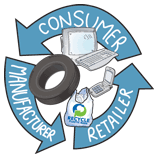
This recent article in the Technology and Science blog, “A Long Term Recycling Plan For Your Products“, highlights the limitations of traditional recycling and the long-term solutions Producer TakeBack programs can offer. From the post:

“Recycling is a great reclamation for our planet and for the environment. But when it comes to our waste problems in America and the world, will recycling alone will bring about a reasonable resolution? The blunt answer is “No”. There are an abundance of reasons for why our current system of consumer recycling will not be enough. Producers and manufacturers have an obligation to their customers and the world to absolutely ensure their products are being recycled by doing things such as partnering and working in concert with waste management institutions. This is the only way real change will take effect to the degree that our planet’s environmental waste crisis demands it. Corporations must take the ultimate responsibility for going green by planning for recycling solutions for all their products before distribution and consumption.”

Read more here.

Fish on Prozac? It’s Time to Take Your Old Meds In

On Saturday Sept. 25 there are events around the country for National Drug TakeBack Day. We don’t want these chemicals flushed down the toilet to pollute our water supplies and the frogs and other animals, or put in our landfills. So this Saturday there are events around Texas to drop off those items. Unfortunately, the big drug companies are still resisting taking responsibility for the end of life of their products. In the short-term there is this one-day event and also a smattering of community pharmacies that are willing to take back unused medicines. Check out the pharmaceuticals link on the left side of this website to get details.

Bag Monster Visits Austin

Andy Keller, the head of the reusable bag company ChicoBag™ company invented Bag Monsters®. Andy had been using a huge ball of 500 plastic bags to show people at farmer’s market how many plastic bags an average American uses yearly – and one day he decided to wear it. Thus was the spawning of the first Bag Monster® (costume that is). This summer the Bag Monster is doing a national tour.

When the Bag Monster arrived in Austin on August 26, he couldn’t have come to town at a better time. The Austin City Council is awaiting the results of a study by our Solid Waste Services Department on the costs to Austin taxpayers of plastic bag waste – those that go to landfills and those that clog storm drains, litter parks or find other places to pollute.

In 2007, the City Council backed a voluntary effort by retailers and others that was supposed to reduce the amount of plastic bags in the waste stream by 50%. The voluntary effort resulted in the distribution of 900,000 reusable bags. However, less than 26% of 3.4 million pounds of plastic bags given out by the five participating retailers were recycled over the 18-month period of the voluntary program.

Thousands of Austin residents have written letters to the Austin City Council to urge them to pass a ban on plastic bags. (Local governments are not authorized by the State of Texas to put a tax on bags.) Local activists are urging retailers to provide incentives such as refunds for people who use reusable bags. One local chain Natural Grocers offers consumers free used cardboard boxes if they don’t have reusable bags.

The Bag Monster is looking for a friendly, pro-plastic bag place to call home. Austinites do not want to put out a welcome mat and instead are looking to the City Council to be the second city in Texas (after Brownsville) to send carry-out plastic bags packing.

Cities, Countries Throughout the World Ban Plastic Bags

Brownsville was the first city in Texas to ban plastic bags, and now Austin is considering following suit. But we’re hardly alone! From a recent CNN report:

Mexico City’s thousands of stores went green Wednesday, as amended ordinances on solid waste now outlaw businesses from giving out thin plastic bags that are not biodegradable. Bans and other restrictions on plastic bags are in place in several countries. China has adopted a strict limit, reducing litter and eliminating the use of 40 billion bags, the World Watch Institute said, citing government estimates. In Tanzania, selling the bags carries a maximum six-month jail sentence and a fine of 1.5 million shilling ($1,137). Mumbai, India, outlawed the bags in 2000 and cities in Australia, Italy, South Africa and Taiwan have imposed bans or surcharges. Ireland reported cutting use of the bags by 90 percent after imposing a fee on each one.

So there’s a growing consensus: plastic bags need to go. California is considering a statewide ban, and it wouldn’t be California without a great video.

Plastic, Disposable UT Tower?

Even one of Austin’s best and brightest institutions is capable of a very bad idea:

More from Austin Business Journal:

“A group of University of Texas alum and environmental activists aren’t happy about plans to market H2Orange, purified water in plastic bottles shaped like UT’s iconic tower. The group is gathering July 23 at UT’s West Campus Mall on Guadalupe Street to protest the plan, saying it undermines Austin’s Zero Waste goal and the campus’ sustainability policy. Instead of using disposable containers, the group is hoping the venture will market ‘a refillable bottle with a UT logo’ as a potential alternative to raising scholarship funds, the group said.”

There are so many ecological and economic problems with bottled water, one hardly knows where to start. Plastic pollution is a serious threat to our ecosystem and although the bottles may be recyclable, there is no guarantee they won’t end up in landfills, incinerators and waterways. In fact, the “great Pacific garbage patch” is larger than Texas and growing every day. And in case you haven’t forgotten about the BP spill: 10% of domestic oil production is used to make plastic products. A great primer is the Story of Bottled Water — check it out!

Beware Sham “E-Cyclers”


This former farmer in China is picking chips off circuit boards by bathing them in acid. Photo: Basel Action Network

Several recent reports have put the spotlight on an issue TCE Fund has been working on since 2002: real, responsible recycling for electronic waste. Unfortunately, the majority of obsolete electronics said to be recycled in America is actually exported and dumped in developing nations across the globe! Discovery News has more:

“Recycling your electronic waste is a noble idea, but here’s the dirty little secret: even if you drop off your old electronics for recycling, it may never get recycled. As OSNews’ Howard Fosdick describes, some people fall victim to a scam called ‘fake recycling,’ and just describing it leaves a bitter taste in my mouth.

Fake recyclers are organizations that approach well-meaning community groups like the Boy Scouts or the Make-a-Wish Foundation to help run a local ‘Recycling Day.’ The idea is that people from the community will bring in their old electronics to the legitimate organization’s Recycling Day event. The fake recycler will then haul that e-waste away, and export it to another country with lax environmental regulations.

The crazy thing is that none of this is illegal, but it’s definitely destroying the environment.”

We couldn’t agree more. If an American company claims to be recycling our old electronics, they shouldn’t be allowed to simply ship the toxic waste to poor, developing nations for a quick buck — they should actually be recycling it. Even people who don’t typically consider themselves environmental advocates should agree we need truth in advertising.

For a fool-proof list of certified, responsible electronics recyclers near you, visit the e-Stewards website.

Local, state officials look to curtail plastic bags

Here’s a great TV story from KVUE News Austin:

“Plastic bags are bad for the environment. Most are produced using oil, and, by some estimates, 90 percent end up dumped in a landfill or clogging up streams. But those free bags can also cost you money, even if you don’t use them. There are more and more proposals being drawn up at the local and state level to eliminate or place a tax on the bags.”

If you’re in Austin, this isn’t a new subject. In 2007 the Austin City Council asked its staff to evaluate options to reduce the use of plastic bags. Then in 2008 the Council passed a resolution and set the goal of reducing the flow of plastic bags into the waste stream by 50% by June 2009. At the request of retailers, the resolution relied mostly on a voluntary program. This was passed as an alternative to a plastic bag ban that was proposed by supporters of the Ban the Bags campaign. However, the voluntary program fell short of the 50% reduction goal, and retailers only recycled about 26% of the amount of plastic they purchased in 2008.

This year, the City of Brownsville became the first in Texas to pass an ordinance banning plastic bags. Wal-Mart and HEB stores in the Brownsville area supported the ban. Austin-based Whole Foods announced a complete ban on plastic bags in their stores. Last year, Natural Grocers, a small business with a branch in Austin, publicly announced that it ceased purchasing plastic bags for the sake of the environment and has saved around 13 million bags.

Texas Campaign for the Environment is helping Austinites urge City Council to take action and pass a ban on plastic bag this year. Involving the retailers to have input on the details is appropriate, but the time for voluntary efforts is over. But you should still recycle your plastic bags at grocery stores, and better yet, simply take reusable bags on your shopping trips. Here are more press reports on a potential plastic bag ban:

Group: Efforts to reduce plastic bag use failed
Environmentalists want a ban on the use of plastic bags
Austin should nix plastic bags, group says

Follow

Get every new post delivered to your Inbox.